
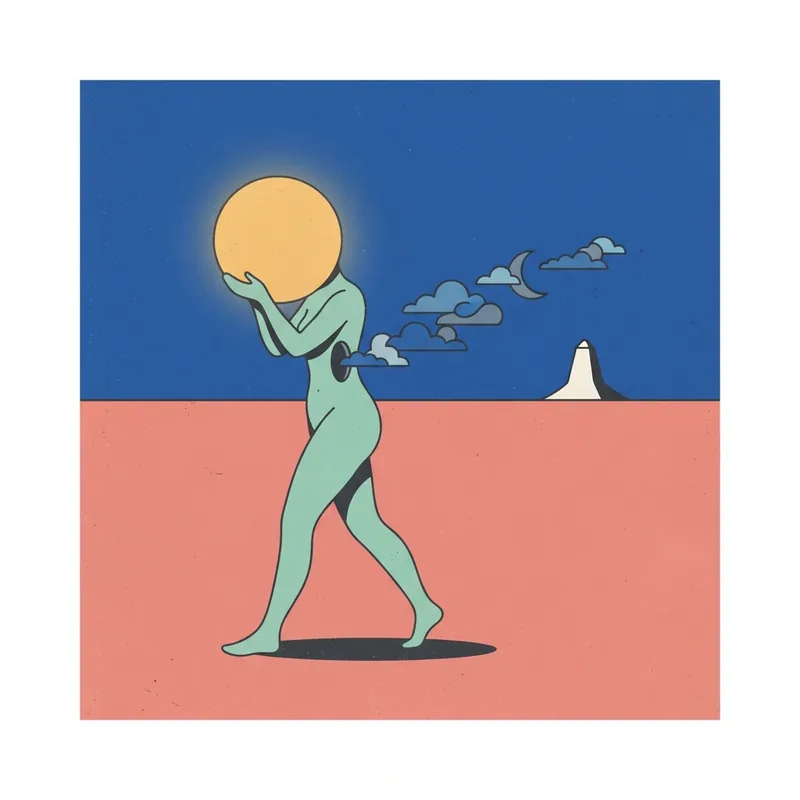
An art and cultural movement that lets the unconscious mind speak, producing dreamlike, illogical scenes built from surprise and unexpected juxtapositions.
Key traits
- Dreamlike
- Painterly
- Narrative
Palette
- #2b3a55
- #c9a66b
- #e8e3d3
Origins
Surrealism grew out of the Dada movement in Europe after World War I. The term was coined by Guillaume Apollinaire in 1917, and the movement was formally established in Paris in 1924 when Andre Breton published the Surrealist Manifesto. Breton framed it as a revolutionary movement merging dream and reality, and it spread worldwide from the 1920s.
Visual language
Scenes are rendered with convincing realism yet assembled illogically, so ordinary objects appear in impossible places or strange scale. Composition favors startling juxtaposition and non sequitur over symmetry. Linework is often precise and descriptive rather than loose, and texture can be smooth and painterly. Motifs include dream imagery, metamorphosis, and floating or melting forms. Typography is usually secondary, serving the image.
Palette and type
Palettes vary widely, from muted, moody earth tones to saturated dream colors, often set against pale skies or dark voids for high contrast. Type is typically restrained and subordinate, letting the strange imagery carry the message rather than decorative lettering.
What it signals
Surrealism reads as dreamlike, uncanny, and psychologically charged. It suggests rebellion against logic and rational order, with a mood that is playful and unsettling at once. Viewers sense a puzzle or hidden meaning behind familiar objects.
Where it works
Works well for editorial illustration, album and book covers, film and poster art, and campaigns wanting mystery or wit. It can overwhelm dense layouts or product clarity, and overuse risks becoming a gimmick rather than a concept.
Related styles
Sources
- Surrealism, Wikipedia accessed 2026-10-22
- Surrealism, Aesthetics Wiki accessed 2026-10-22