
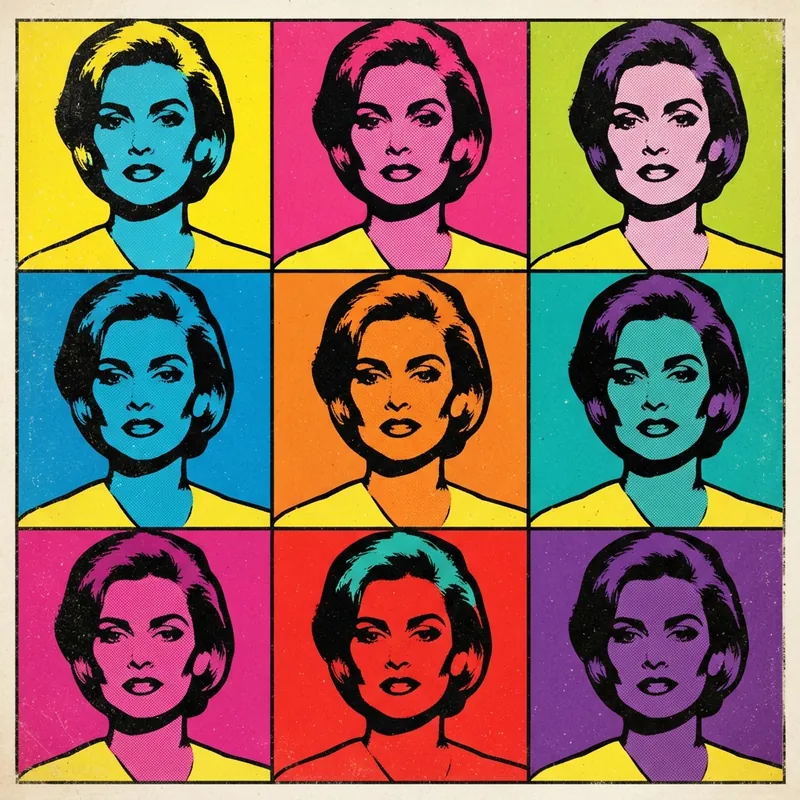
Drawing directly from advertising, comic strips, and consumer packaging, Pop Art turned commercial printing techniques — halftone dots, thick outlines, flat saturated color — into a fine-art and design language. It's loud on purpose, celebrating (or satirizing) mass production and consumer culture.
Key traits
- Saturated
- High contrast
- Playful
Origins
Pop Art emerged in Britain and the United States during the mid-1950s and became a defining movement of the following decade. It drew on advertising, comic strips, product packaging, and celebrity photography, collapsing the boundary between commercial culture and fine art. Lawrence Alloway coined the term in 1958, and artists such as Andy Warhol, Roy Lichtenstein, Richard Hamilton, and Claes Oldenburg pushed its deadpan, image-sourced approach into painting, sculpture, and print.
Visual language
Pop Art borrows the look of mechanical reproduction: flat areas of color, heavy black outlines, Ben-Day dots, halftone patterns, and hard-edged crops. Images are repeated in grids or serial rows, as if pulled from a press run. Comic panels, speech balloons, product labels, and newsprint textures are common. The composition is direct and legible, often using a single iconic object or face as the whole subject.
Palette and type
Saturated primaries and secondaries dominate, especially red, yellow, blue, black, and white. Color is flat and unmodulated, with little shading. Typography often mimics advertising: bold sans serifs, comic lettering, stacked headlines, and speech bubbles. The type is part of the image rather than a quiet caption.
What it signals
Pop Art signals irony, humor, and accessibility. It can celebrate consumer culture and critique it at the same time, which makes it useful for brands that want to be knowing rather than earnest.
Where it works
It works for packaging, apparel, posters, editorial spreads, web campaigns, and cultural branding with a playful or satirical edge. It is less effective when a project needs subtlety, luxury, or a purely functional tone.
Related styles
Sources
- Kittl — Detailed visual guide accessed 2026-10-18
- Aesthetics Wiki — Pop Art accessed 2026-10-18