
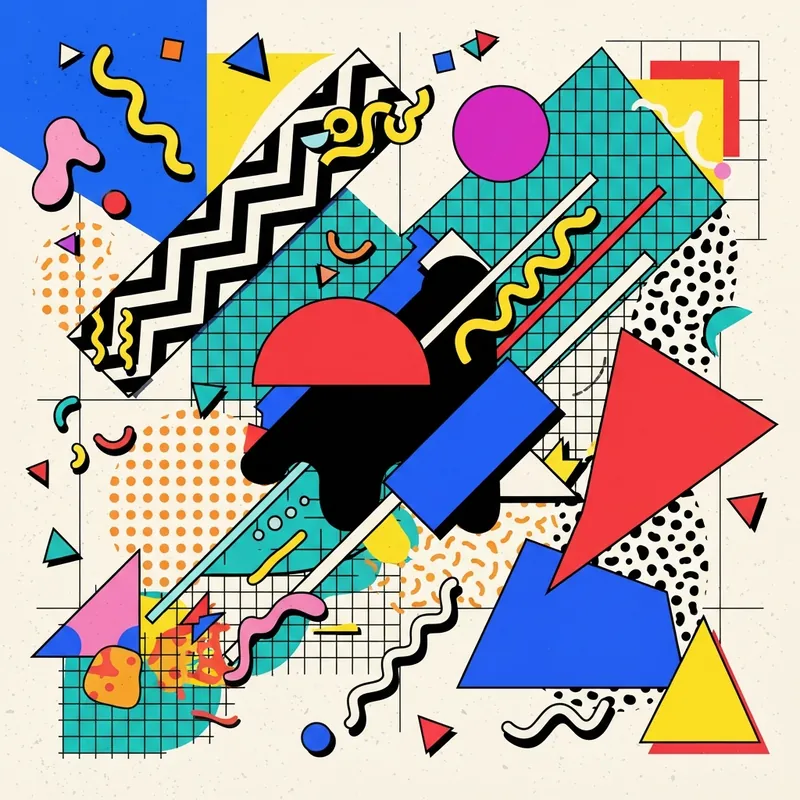
Founded by Ettore Sottsass and the Memphis Group as a deliberate revolt against tasteful, "serious" modernism. It throws together squiggles, confetti dots, and clashing color combinations with intentional irreverence — kitsch as a design philosophy.
Key traits
- Geometric
- Playful
- Eclectic
Origins
Memphis Design began in Milan in 1980, when Ettore Sottsass and a group of designers and architects formed a collective willing to challenge functionalist restraint. The group debuted in 1981 and disbanded in 1987, but its visual vocabulary spread through furniture, interiors, graphics, and fashion. Its name came from a Bob Dylan song, and its influence later resurfaced in retro digital styles such as vaporwave and synthwave.
Visual language
Memphis is built from loud, deliberately mismatched geometry: squiggles, zigzags, dots, grids, triangles, and asymmetric blocks. Patterns are layered rather than resolved, and objects often look like toys or stage props. Surfaces may suggest plastic laminate, terrazzo, or painted wood. The composition is playful and unstable, with a clear rejection of the tidy grid and the neutral palette.
Palette and type
Pink, blue, yellow, red, purple, teal, black, and white are typical, often in clashing combinations. Pastels and neon accents can sit beside primary colors. Typography tends toward bold geometric sans serifs or quirky display faces; lettering may be angled, outlined, or treated as another pattern element.
What it signals
Memphis signals playfulness, irreverence, and postmodern confidence. It can feel experimental and energetic, or chaotic and dated when the references are used without a clear hierarchy.
Where it works
It works for retro branding, editorial features, packaging, apparel, music and event posters, and social campaigns with an 1980s or postmodern theme. It is a poor fit for calm, utility-first interfaces.
Related styles
Sources
- Kittl — Detailed visual guide accessed 2026-10-18
- Aesthetics Wiki — Memphis Design accessed 2026-10-18