
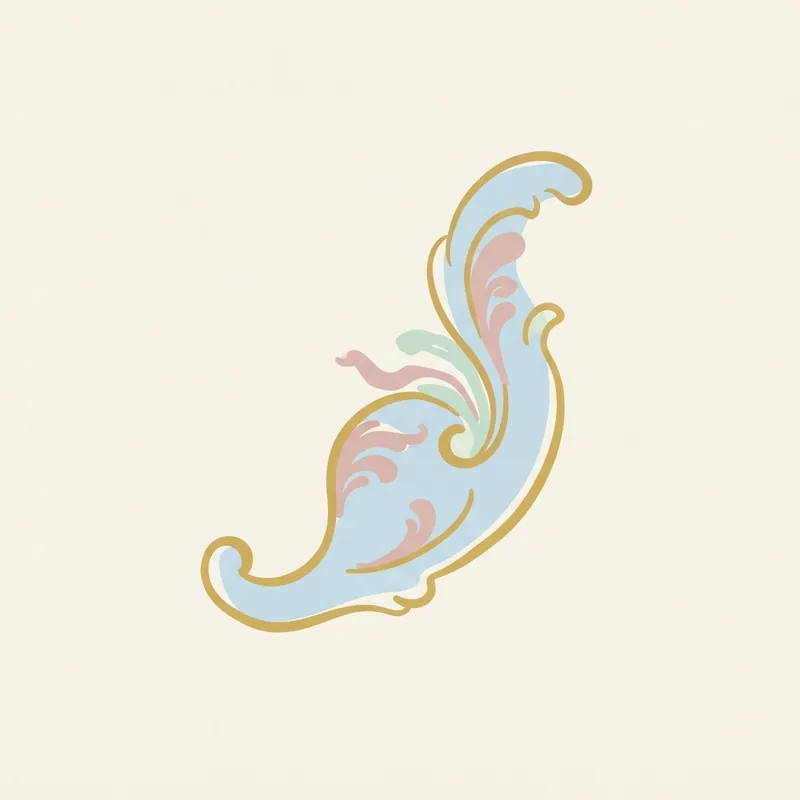
An ornate, playful French style of interiors, art, and decoration marked by fluid curves, asymmetry, pastel colours, gilding, and shell-like rocaille motifs.
Key traits
- Ornate
- Fluid
- Pastel
Palette
- #f7e7ce
- #f4c2c2
- #d4af37
Origins
Rococo emerged in France in the 1730s as a reaction against the grand, formal Louis XIV style. It began in domestic interiors and spread across Europe, especially to northern Italy, Austria, southern Germany, Central Europe, and Russia. The style was later adapted for church architecture and remained widespread in Central Europe, Portugal, and South America until Neoclassicism largely replaced it by the late 18th century.
Visual language
Rococo is recognizable by its fluid C and S curves, counter-curves, and deliberate asymmetry. Ornament draws on rocaille shell and pebble motifs, acanthus scrolls, flowers, birds, putti, and sometimes chinoiserie elements such as pagodas and monkeys. Interiors contrast simple exteriors with densely decorated rooms, using carved wood panelling, mirrors, and trompe-l'oeil frescoes to create intimacy and spatial illusion. Forms are lighter and smaller in scale than Baroque, with furniture scaled down and rooms designed for private comfort rather than public display.
Palette and type
The palette favours pale pastels such as soft yellows, creams, pearl greys, powder blues, pinks, and mint greens, accented with ivory whites and gold leaf gilding. Type treatment is typically ornamental and curvilinear, echoing scrollwork and cartouche frames rather than modern sans-serifs.
What it signals
Rococo communicates lightness, elegance, leisure, and aristocratic intimacy. It suggests playful romance, refined comfort, and decorative excess, with a mood that is theatrical yet delicate. The style is often associated with pastimes, courtship, and pastoral fantasy rather than moral seriousness or public power.
Where it works
Rococo works well for editorial layouts about art history, luxury interiors, wedding and event styling, and packaging that needs a delicate, ornamental feel. It can overwhelm small interfaces or modern brand systems, and heavy use risks looking pastiche or overly decorative.
Related styles
Sources
- Rococo, Wikipedia accessed 2026-10-22
- Rococo, Aesthetics Wiki accessed 2026-10-22