
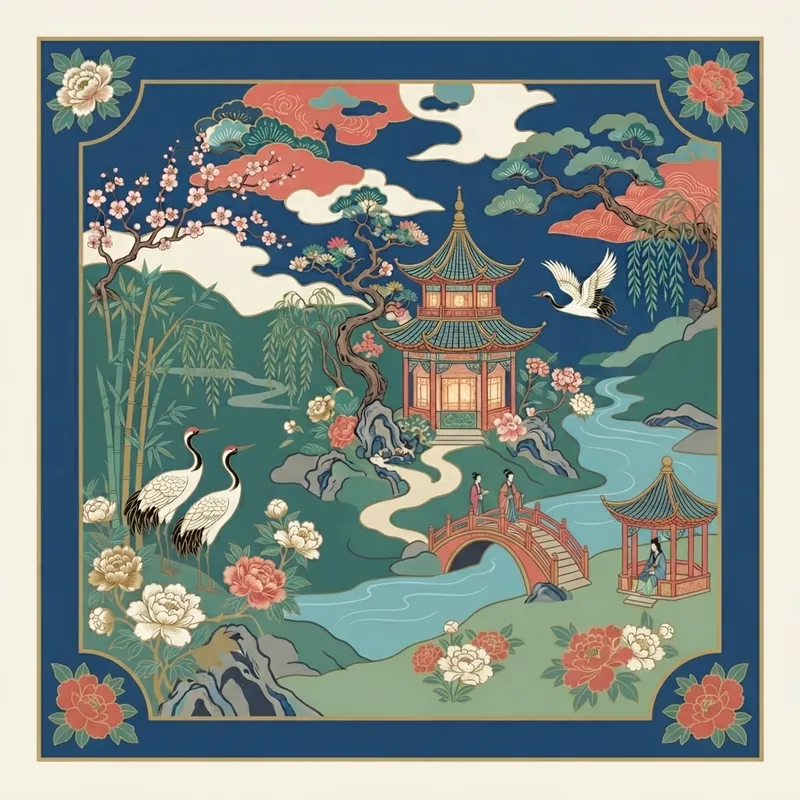
Western reinterpretation of Chinese motifs — cranes, peonies, pagodas — as scenic, patterned vignettes.
Key traits
- Patterned
- Illustration-led
- Ornate
Origins
Chinoiserie developed in Europe during the seventeenth and eighteenth centuries, especially in France, as trade brought Chinese porcelain, silk, and lacquerware to European courts. Rather than reproducing Chinese art faithfully, European designers created a fantasy of East Asia shaped by imagination and luxury demand. The style became closely tied to Rococo interiors and spread through wallpaper, furniture, ceramics, and textiles. François Boucher and Jean-Baptiste Pillement are among its associated artists.
Visual language
The visual vocabulary is decorative and scenic: pagodas with upturned roofs, weeping willows, peonies, bamboo, cranes, dragons, cloud forms, and small figures in imagined costume. Lattice frames and dense borders organize wallpaper-like repeats, while vignettes layer foreground and background like a stage set. Fine linework and porcelain-inspired blue-and-white patterns give the style a delicate, crafted surface. Asymmetry borrowed from Rococo keeps compositions lively rather than rigid.
Palette and type
Porcelain blue and white are the signature pairing, joined by jade green, lacquer red, black, gold, and soft pastel grounds. The effect is curated rather than bright. Typography often uses fine serifs, engraved capitals, or calligraphic scripts that echo the linework without pretending to be Chinese lettering.
What it signals
Chinoiserie signals heritage, craft, and collected luxury, with a note of fantasy and play. It can also read as costume or stereotype when the cultural borrowing is unexamined.
Where it works
It works for wallpaper, textiles, ceramics, premium packaging, hotel and restaurant identities, stationery, and editorial features on interiors. Use it as a decorative layer around a clear modern core; a full system can feel theatrical or dated.
Related styles
Sources
- Kittl — Detailed visual guide accessed 2026-10-16
- Aesthetics Wiki — Chinoiserie accessed 2026-10-16