
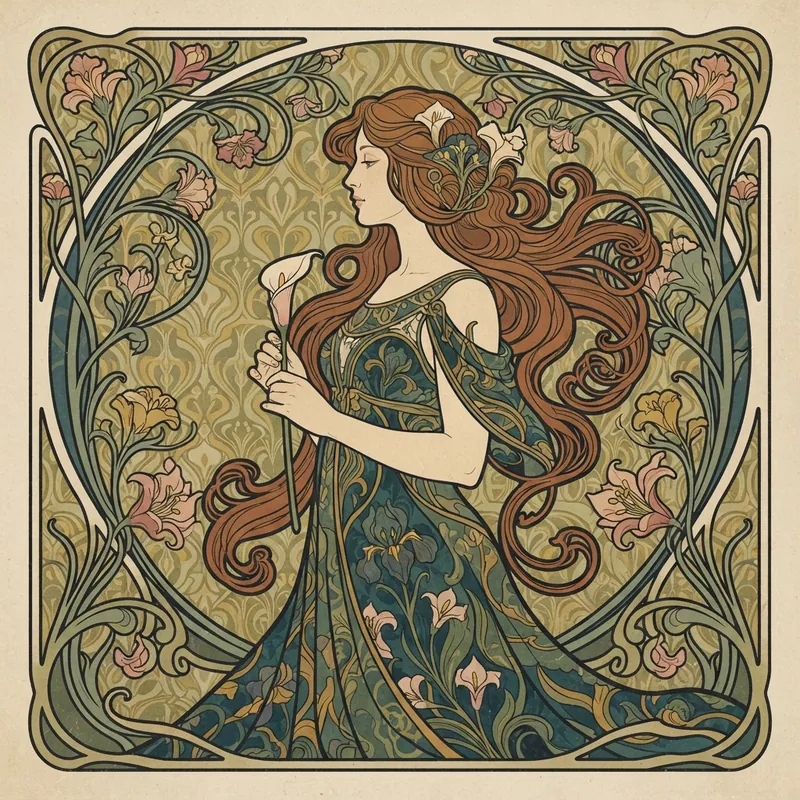
Whiplash curves and plant-derived motifs, with type and illustration fused into one flowing composition.
Key traits
- Organic
- Ornate
- Illustration-led
Origins
Art Nouveau flourished in Western Europe from the 1890s to the 1910s. It reacted against academic historicism and the growing anonymity of industrial production, arguing that fine art and applied art should be united in a total design. The movement appeared under many regional names, including Jugendstil in Germany, Secessionstil in Austria, Modern Style in Britain, and Modernisme in Catalonia. Alphonse Mucha, Hector Guimard, Victor Horta, and Antoni Gaudí are among its best-known figures.
Visual language
The style is defined by the whiplash curve: a long, sinuous line that switches direction and rarely settles into a straight edge. Plant stems, vines, flowers, insects, peacock feathers, and flowing female figures are common. Illustration, ornament, and type are treated as one continuous surface rather than separate layers. Borders and frames often grow out of the same organic vocabulary, giving posters and book covers a unified, handcrafted feel.
Palette and type
Muted olive, mustard, brown, lilac, and sage dominate, with gold or silver accents and pale backgrounds. Color is often applied in flat, decorative areas. Typography is fluid and custom: elongated serifs, curling terminals, and letterforms that bend with the illustration rather than sitting above it.
What it signals
Art Nouveau signals romance, nature, and individual craftsmanship. It can feel sensual and progressive, or nostalgic and heavily decorative, depending on how much ornament is allowed.
Where it works
It suits posters, book covers, perfume and beauty branding, cafe identities, packaging, and editorial features with a romantic or botanical subject. For modern systems, it works best as a display layer rather than a body-text style.
Related styles
Sources
- Kittl — Detailed visual guide accessed 2026-10-16
- Aesthetics Wiki — Art Nouveau accessed 2026-10-16