
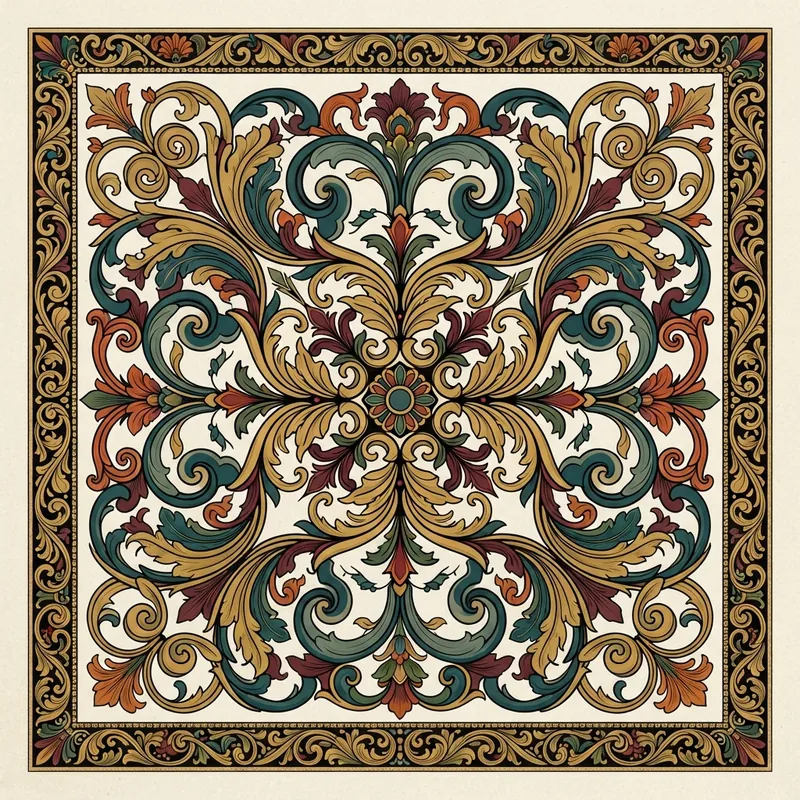
Carved, curling leaf ornament borrowed from classical column capitals — used as premium detailing, not a whole layout.
Key traits
- Ornate
- Symmetrical
- Organic
Origins
Acanthus ornament takes its name from a Mediterranean plant whose deeply cut leaves were stylized in Greek and Roman architecture. It appears most famously on Corinthian and Composite column capitals, where carved leaves curl around a central volute. Because the motif can be carved, engraved, or printed at almost any scale, it persisted as a classical detail and still appears in contemporary ornament, making it one of the most durable decorative forms.
Visual language
The motif is built from layered, curling leaves with sharp lobes and a rhythmic, scroll-like movement. It usually appears as an accent: corner flourishes, borders, frames, crests, or a capital-like crown above a composition. Symmetry and mirrored pairs are common, and the carved original translates into fine engraved lines, dense shading, and a sense of stone or metal relief. Acanthus rarely supplies a whole layout; it frames one.
Palette and type
Stone, ivory, and parchment backgrounds are common, with gold, bronze, or dark green detailing. Monochrome engraving is effective because it preserves the leaf's depth. Typography usually pairs with high-contrast serifs, Roman capitals, or formal display lettering that matches the ornament's classical authority.
What it signals
Acanthus signals tradition, craftsmanship, and old-world luxury. It can read as ceremonial and refined, or as stiff and dated when the ornament is applied without restraint.
Where it works
It works on premium packaging, wedding invitations, stationery, wallpaper, picture frames, crests, and editorial mastheads. Treat it as a supporting detail around a clean core rather than a full visual system.
Related styles
Sources
- Kittl — Detailed visual guide accessed 2026-10-16