
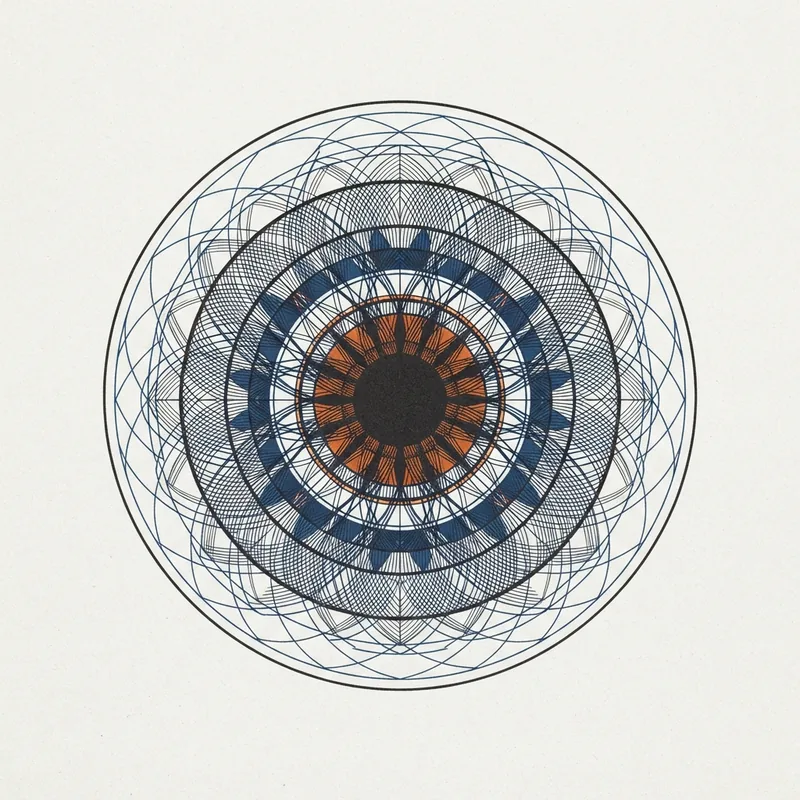
Algorithmic art where rules, code, or mathematical procedures draw the image, often output through pen plotters or mathematical art software. Precise lines, repetition, and system-driven pattern replace the artist's hand.
Key traits
- Geometric
- Digital
- Patterned
Palette
- #111111
- #f4f1e8
- #c8452f
Origins
Generative and plotter art grows from mathematical art practice and algorithmic image making, supported by software catalogued in lists of mathematical art software. Pen plotters, machines that draw programmed line paths with physical pens, gave the approach a material output. The tradition connects to creative coding and procedural tools, and to earlier algorithmic drawing experiments, though exact dates and pioneers are debated.
Visual language
Compositions are built from repeated line work, plotted curves, lattices, and dense hatching rather than brushwork. Shapes often emerge from simple rules applied many times, producing moire, spirals, tiling, and parametric surfaces. Lines are uniform and mechanical, with visible pen paths and occasional ink gaps. Texture comes from line density, not grain. Typography, when present, tends to be plotted, geometric, and secondary to the pattern.
Palette and type
Palettes are usually limited: black ink on white or cream paper, single-colour pens, or small sets of flat plotter inks. Colour is applied as separate line passes. Type is rare and typically simple, monospaced, or plotted stroke lettering that reads as part of the system rather than as display typography.
What it signals
The mood is analytical, ordered, and quietly technical, communicating process, precision, and machine authorship. It reads as experimental, computational, and craft-adjacent, appealing to viewers interested in systems, mathematics, and the physical trace of code.
Where it works
Works well for posters, editorial illustration, album art, generative identities, and gallery prints where pattern and process are the point. Avoid it when warmth or human spontaneity is needed, and watch for overuse of dense line fields that become visual noise at small sizes.
Related styles
Sources
- List of mathematical art software, Wikipedia accessed 2026-10-23
- Net.art, Aesthetics Wiki accessed 2026-10-23