
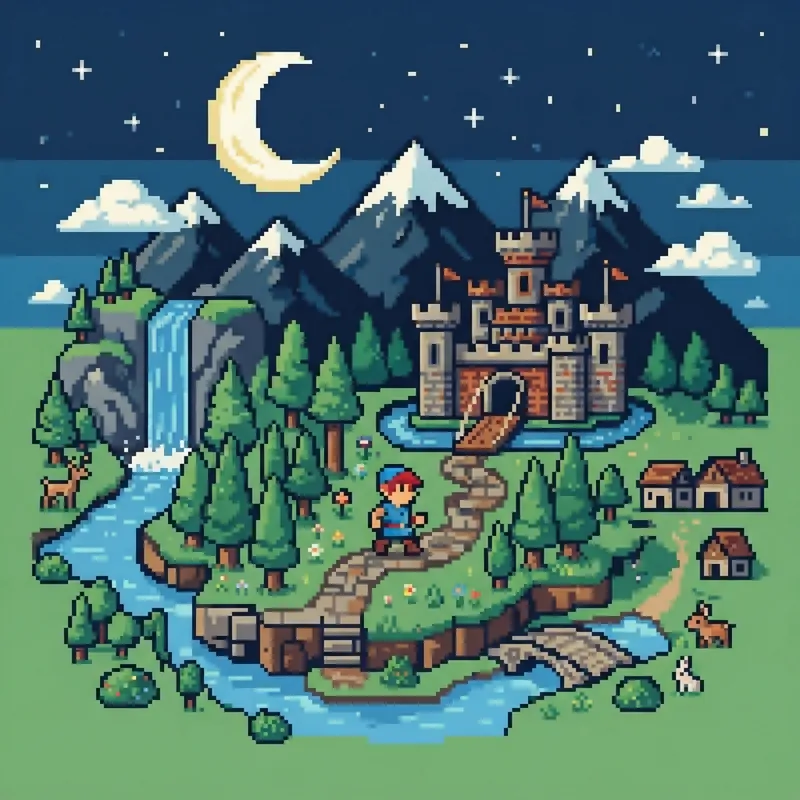
Blocky, low-resolution graphics born from old hardware limits, now a nostalgic style choice.
Key traits
- Geometric
- Digital
- Nostalgic
Origins
Pixel art comes from the early decades of video games, when hardware imposed severe limits on resolution and color. Consoles and arcade machines produced blocky sprites because that was what the technology allowed, not because designers chose the look. Indie developers revived the style in the 2010s, and its constraints became a deliberate aesthetic rather than a technical necessity.
Visual language
Images are built from a visible grid of square pixels. Silhouettes are simple and readable, and every pixel is placed with intent. Limited color palettes, hard edges, and sprite-like forms are common. Dithering or outlines may be used to suggest shading, but the low resolution remains visible. Animation often relies on a few frames and exaggerated poses to communicate motion.
Palette and type
Palettes are restricted, often to a handful of bright colors with black or white for contrast. Retro hardware palettes and high-contrast primaries are common. Typography is usually a bitmap or pixel face, sometimes with a hard drop shadow; smooth vector type breaks the illusion.
What it signals
Pixel art signals nostalgia, playfulness, and clever constraint. It can feel charming and crafted, or gimmicky when the pixel grid is applied to work that does not need it.
Where it works
It works for games, social posts, merch, packaging, event posters, and web accents with a retro-gaming theme. It is less suited to luxury editorial or small-scale interfaces where legibility matters.
Related styles
Sources
- Kittl — Detailed visual guide accessed 2026-10-21
- Aesthetics Wiki — 8-Bit accessed 2026-10-21