
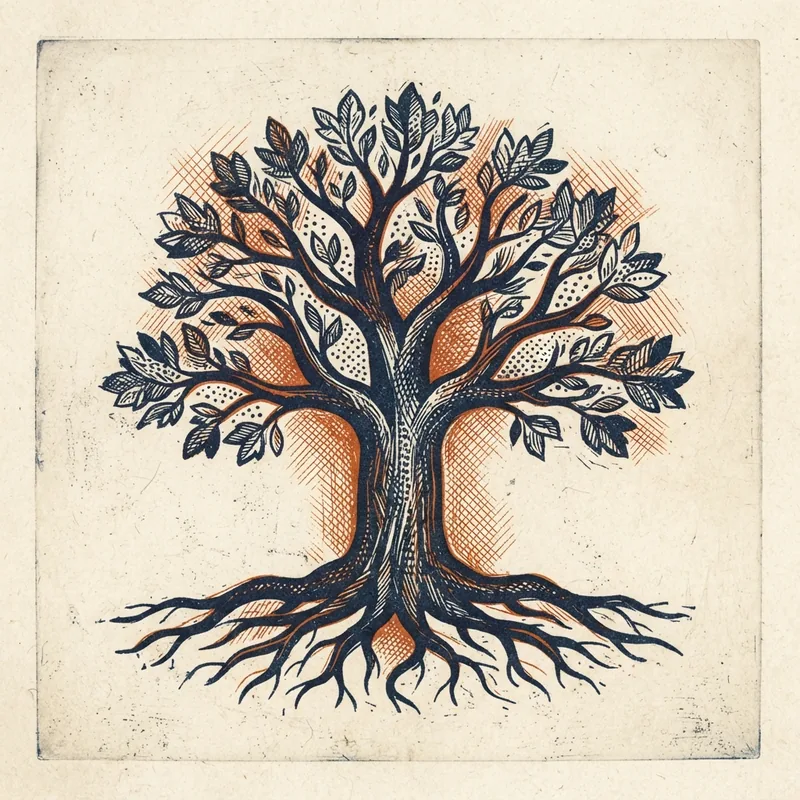
Etching / Intaglio is a fine-art printmaking style built from fine incised lines bitten into metal plates, producing delicate, densely hatched images with a hand-pulled, old-master character.
Key traits
- Textured
- Hand-drawn
- Dense
Palette
- #f2ead9
- #2b2620
- #8a6f4e
Origins
Etching / Intaglio grew from metalworking and armour decoration known in Europe since at least the Middle Ages. The printmaking process is commonly credited to Daniel Hopfer of Augsburg, Germany, around the turn of the 16th century, who adapted acid-bitten iron plates to printing. It spread from German-speaking lands and Central Europe across the Alps, becoming a leading technique for old master prints alongside engraving.
Visual language
Lines are the whole vocabulary: fine, scratchy strokes cut with a needle, plus swelling lines made with a slanted échoppe tool. Artists build tone through cross-hatching and dense parallel shading rather than flat fills. Composition often feels drawn and intimate, with careful contour and layered detail. The bitten line has a slightly ragged, organic edge, and plates are frequently combined with engraving or aquatint for richer depth.
Palette and type
Prints read mostly as black or sepia ink on warm cream or off-white paper, sometimes with plate-tone greys. Colour is usually absent or added sparingly by hand. Lettering, when present, is small, formal, and often engraved or inscribed in a serif face beneath the image.
What it signals
Etching / Intaglio signals craft, scholarship, and old-master heritage. The fine hatching and monochrome restraint suggest historical illustration, natural-history plates, and fine-art printmaking, communicating precision and quiet seriousness rather than mass-produced slickness.
Where it works
Works well for editorial illustration, bookplates, botanical and anatomical imagery, and heritage branding that wants a handmade, scholarly feel. It can look fussy or overly antique at small sizes, and heavy hatching becomes muddy when scaled down or printed cheaply.
Related styles
Sources
- Etching, Wikipedia accessed 2026-10-23
- Bootleg Aesthetic, Aesthetics Wiki accessed 2026-10-23