
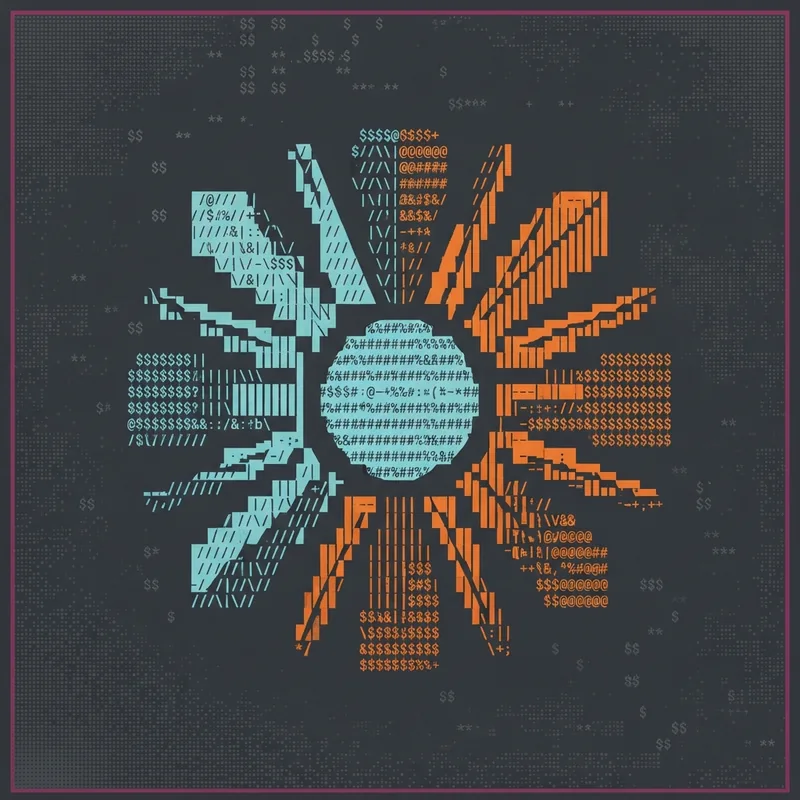
ASCII art makes pictures from the fixed-width text characters of the ASCII standard, building images, logos, and scenes out of letters, numbers, and symbols.
Key traits
- Digital
- Typography-led
- Nostalgic
Palette
- #0d0d0d
- #e8e8e8
- #33ff66
Origins
ASCII art grew out of early computing at Bell Labs, where Kenneth Knowlton produced character-based images around 1966, including "Studies in Perception I" with Leon Harmon. It spread because early printers often could not output graphics, so characters stood in for marks. Bulk printers also used large character banners to separate print jobs. From the late 1970s and early 1980s it flourished on bulletin board systems and in email.
Visual language
Images are assembled entirely from printable characters, so shapes are suggested by the density and arrangement of symbols rather than drawn lines. Faces, objects, and lettering emerge from clusters of punctuation, slashes, and brackets. Composition depends on a fixed-width grid, with each character occupying equal space. The overall look is blocky, textural, and unmistakably typed, and it relies on monospaced fonts such as Courier or Consolas to hold together.
Palette and type
Colour is usually limited to the foreground and background of a terminal or text editor, often light characters on dark or the reverse. Extended character sets and ANSI colour can add accents. Typography is the medium itself: monospaced, evenly spaced, and read as texture as much as text.
What it signals
ASCII art reads as early computing, hacker culture, and text-only online spaces. It signals resourcefulness and nostalgia for bulletin boards, MUDs, and terminal interfaces, and it can feel playful, technical, or deliberately lo-fi.
Where it works
It suits terminal tools, banners, zines, retro web pages, and playful typographic logos. It works poorly when fine detail or colour realism is needed, and heavy use can become hard to read or feel like a novelty.
Related styles
Sources
- ASCII art, Wikipedia accessed 2026-10-23
- Net.art, Aesthetics Wiki accessed 2026-10-23