
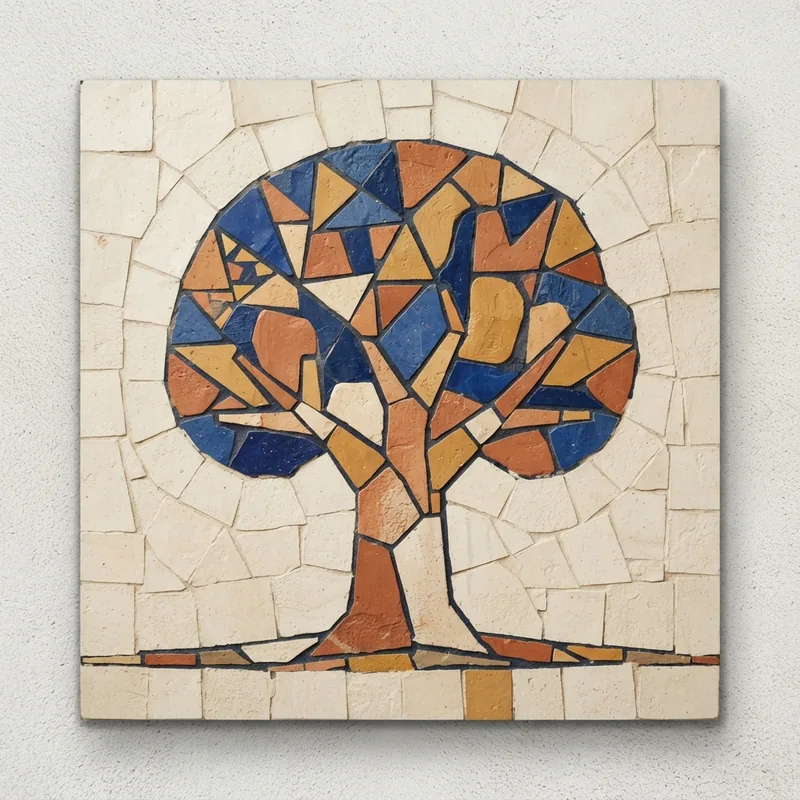
Mosaic is an image or pattern built from small pieces of stone, glass, or ceramic set into mortar. It ranges from ancient floor pavements to modern artwork made from almost any material.
Key traits
- Patterned
- Textured
- Geometric
Palette
- #c8a24a
- #2f5d8a
- #a8452f
Origins
Mosaic began in Mesopotamia in the 3rd millennium BC, with early examples of coloured stone, shell, and ivory found at a temple in Abra. Pebble mosaics appeared at Tiryns in Mycenean Greece. Patterned and figural mosaics spread through classical Greece and Rome, then flourished in early Christian basilicas and the Byzantine Empire from the 6th to 15th centuries. The technique declined in the Renaissance but never disappeared.
Visual language
Mosaic is defined by tessellation: surfaces are covered in small regular or irregular pieces, called tesserae, separated by visible mortar lines. Traditional tesserae are roughly square cubes of stone or glass enamel. Compositions range from geometric borders and repeating patterns to large figurative scenes, often with strongly emphasized frames. Texture is physically bumpy and gridded by the joints. Lettering, when present, is usually built from the same cut pieces rather than drawn.
Palette and type
Palettes follow available stone and glass: earthy ochres, terracotta, deep blues, greens, gold, and white. Byzantine work favours gold grounds and saturated colour. Type is uncommon and typically rendered in mosaic tesserae, giving letters a blocky, stepped edge rather than a smooth stroke.
What it signals
Mosaic signals permanence, craftsmanship, and antiquity. It carries associations with Roman villas, Byzantine churches, and Islamic geometric tilework such as zellij. The visible joints and slight irregularity read as handmade and materially honest rather than slick.
Where it works
Mosaic works for architectural surfaces, floors, murals, signage, and decorative panels. It suits cultural, heritage, and religious contexts. It is a poor fit for small type or fine detail, and imitation mosaic textures can quickly look busy or cheap when overused.
Related styles
Sources
- Mosaic, Wikipedia accessed 2026-10-23