
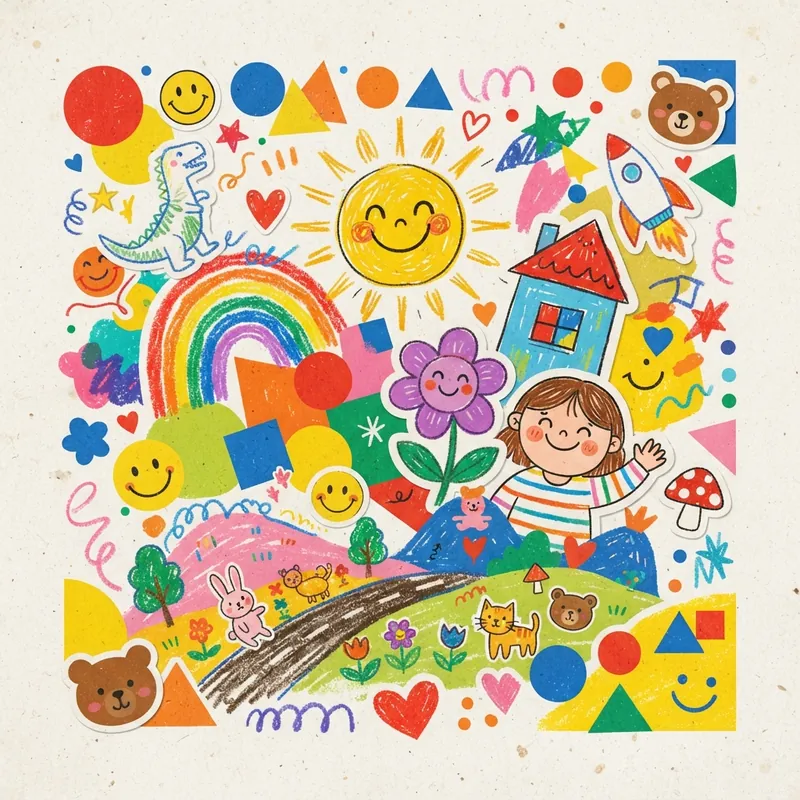
Crayon color, stickers, and naive shapes — a reaction against minimalist sameness, favoring personality over polish.
Key traits
- Playful
- Hand-drawn
- Saturated
Origins
Kidcore emerged on Tumblr in the late 2010s and spread through TikTok and Instagram around 2020. It draws on the toys, media, and classroom materials of a 1990s or early-2000s childhood, using nostalgia as comfort and escapism. The style overlaps with Decora and dopamine dressing, but it places less emphasis on elaborate fashion and more on accessible, playful self-expression.
Visual language
Kidcore looks assembled from a child's art supplies and toy box: crayon marks, stickers, rainbow arcs, alphabet blocks, cartoon characters, and simple hand-drawn shapes. Layouts can be collage-like and intentionally imperfect, with visible outlines, uneven fills, and mixed media. Repetition and bright color blocking create energy. The style values expression and recognizability over polish or restraint.
Palette and type
Bright primaries and rainbow combinations dominate, with neon accents and saturated secondary colors. White or paper grounds keep the chaos readable. Typography is often handwritten, rounded, comic-like, or sticker-style; letters may be outlined, tilted, or arranged in playful arcs.
What it signals
Kidcore signals nostalgia, innocence, comfort, and a refusal to grow out of play. It can feel joyful and personal, or childish and chaotic when the references overwhelm the message.
Where it works
It works for apparel, stickers, packaging, social campaigns, toys, youth brands, and event promotion. It is a poor fit for formal, regulated, or premium contexts.
Related styles
Sources
- Kittl — Detailed visual guide accessed 2026-10-18
- Aesthetics Wiki — Kidcore accessed 2026-10-18