
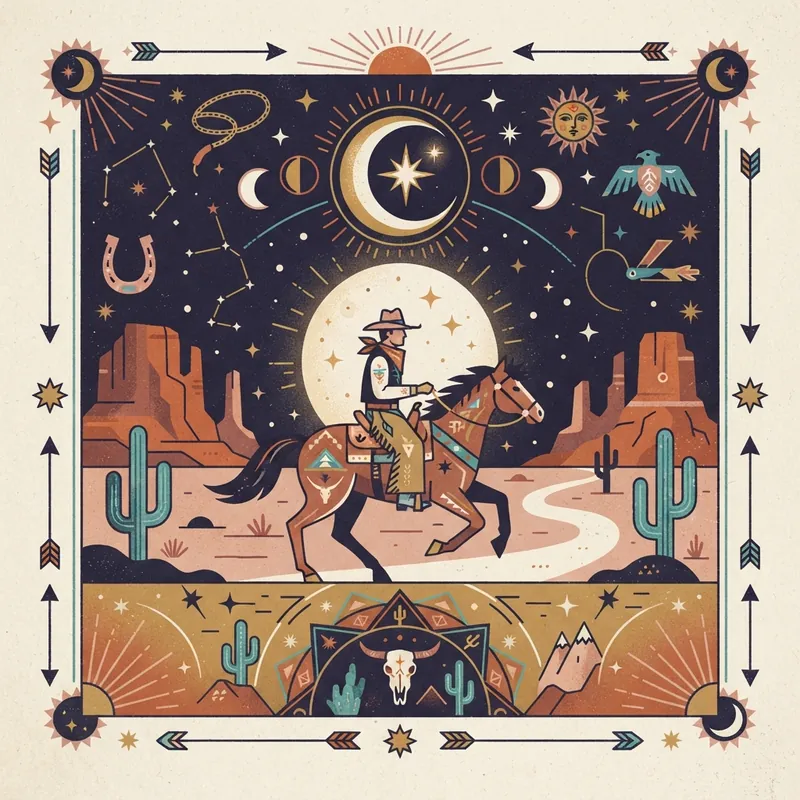
Cowboy iconography meets celestial imagery — desert landscapes with a cosmic, spiritual twist.
Key traits
- Earthy
- Celestial
- Eclectic
Origins
Mystical Western is a contemporary fusion rather than a historical movement. It pairs classic cowboy imagery with celestial and spiritual symbols, drawing on the mythology of the American West and a dreamier, alternative-culture sensibility that took shape in the 2010s. The result is a frontier that feels enchanted rather than documentary.
Visual language
Desert landscapes, moonlit skies, stars, sunsets, cacti, horses, boots, and wide-brim hats establish the Western layer. Tarot-like symbols, eyes, moons, and cosmic patterns add the mystical layer. Compositions often feel like posters or album art, with a central emblem, arched type, and atmospheric light. The palette and symbols should feel weathered and personal, not slick.
Palette and type
Dusty earth tones, terracotta, sand, sage, and deep indigo dominate, with silver, gold, or bone accents. Typography mixes Western display serifs, hand-lettered signs, and celestial or occult-inspired lettering; the contrast is part of the style.
What it signals
Mystical Western signals wanderlust, mystery, and a spiritualized frontier. It can feel evocative and cinematic, or costume-like when the symbols have no connection to the story.
Where it works
It works for festival posters, indie apparel, music branding, packaging, book covers, and experiential events. It is a poor fit for corporate, technical, or luxury-minimal contexts.
Related styles
Sources
- Kittl — Detailed visual guide accessed 2026-10-18