
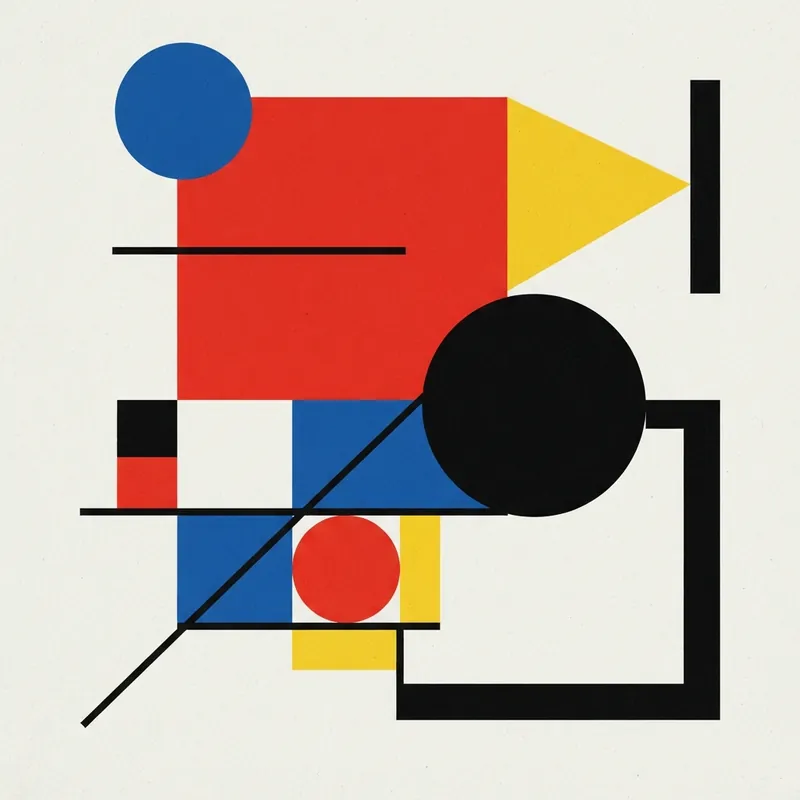
Born at Germany's Bauhaus school, this style treats the circle, square, and triangle as a universal visual alphabet, paired with primary red, yellow, and blue. It fused fine art with industrial production — design meant to be functional, reproducible, and stripped of ornament.
Key traits
- Geometric
- Saturated
- Ordered
Palette
- #e30613
- #0057a8
- #f4c400
- #1a1a1a
Origins
Bauhaus was a German art school founded by Walter Gropius in Weimar in 1919 and active until 1933, later moving to Dessau and Berlin. It set out to unite fine art, craft, and industrial production, training designers to make functional objects for modern life. The school's principle of form follows function rejected unnecessary ornament and embraced mass production. Its influence spread worldwide before the school closed under Nazi pressure.
Visual language
Compositions rely on circles, squares, triangles, straight lines, and clear geometric structure. Asymmetry and grids replace centered ornament. Sans-serif type, abstract forms, and functional layouts carry the message. Primary colors and simple shapes are used as a visual alphabet rather than decoration. Every element should serve a purpose, and the overall effect is ordered, legible, and unsentimental.
Palette and type
Primary red, yellow, and blue dominate, usually with black, white, or grey. Color is applied in flat areas and used to organize information. Typography favors geometric sans-serif faces with simple letterforms and functional hierarchy; lowercase settings and stark contrast are common.
What it signals
Bauhaus signals rationality, progress, and democratic design. It can feel clear and confident, or austere and impersonal when the functional logic leaves no room for warmth.
Where it works
It works for architecture and design studios, editorial systems, cultural institutions, technology brands, and product identities. It is less suitable for projects that need historical texture, ornament, or a playful handmade voice.
Related styles
Sources
- Kittl — Detailed visual guide accessed 2026-10-21
- Aesthetics Wiki — Bauhaus accessed 2026-10-21